There is a very specific kind of pause that almost every language learner knows. Someone asks you a question in German. You know the words. You have probably written a version of this exact sentence in a workbook. And still, for a second (or ten), nothing comes out.
That pause is not a vocabulary problem. It is a fear problem. And once you actually break it apart, it becomes a lot easier to deal with.
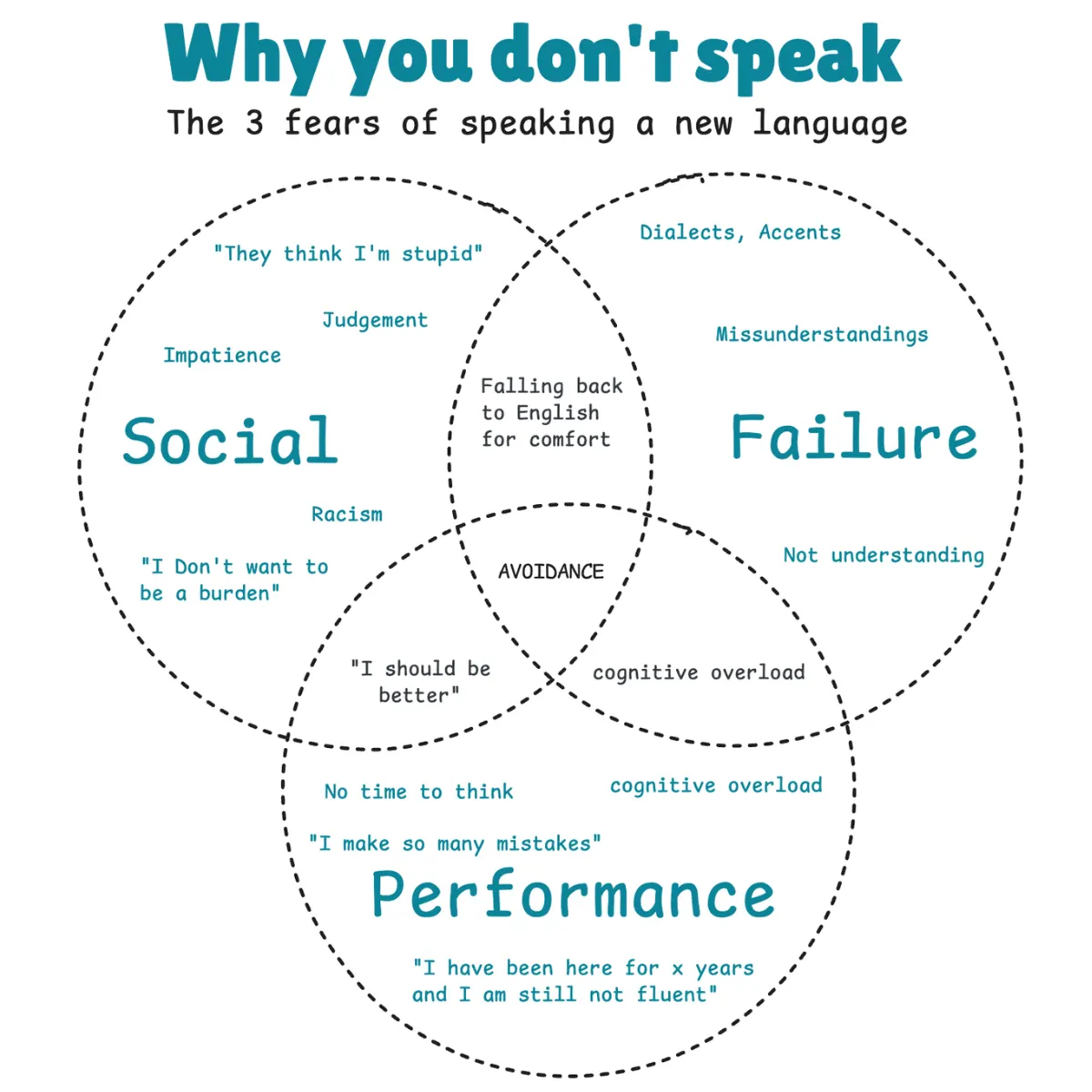
The social fear
This is the fear of what other people will think of you. It sounds like “they think I’m stupid,” or the quieter, more corrosive version: “I don’t want to be a burden.” It shows up as fear of judgment, of someone’s impatience while you search for a word, and in the worst cases, as fear of outright racism or exclusion. This fear is not really about grammar at all. It is about status, belonging, and whether the room will still be friendly to you once you stumble.
The fear of failure
This is the fear of not getting the message across, or not understanding the message coming back. Dialects and accents make it worse. Freiburg’s own Alemannic dialect is a great example: even fluent German speakers from other regions get thrown off by it. It shows up as fear of misunderstandings, of simply not understanding what was said, and of the small panic that follows both.
The performance fear
This is the fear of your own output. “I make so many mistakes.” “I’ve been here for years and I’m still not fluent.” It is the pressure to perform well in the moment, made worse by the simple fact that speaking a foreign language is cognitively expensive: you are translating, conjugating, and self-monitoring all at once, in real time, with someone waiting for your answer.
Where it gets interesting: the overlaps
None of these fears live in isolation. They overlap, and the overlaps are often where the real damage happens.
Social fear plus failure fear often produces the instinct to fall back to English for comfort, the moment where you know you could push through in German, but the social discomfort of stumbling combines with the fear of being misunderstood, and English feels like the safer exit.
Performance fear plus social fear tends to produce a quieter, more self-critical thought: “I should be better by now.” It is judgement, just aimed inward instead of outward.
Failure fear plus performance fear shows up as pure cognitive overload, the moment your brain is juggling grammar, vocabulary, and social reading all at once and simply runs out of bandwidth.
And where all three circles overlap, you get the actual behavior that stops people from progressing: avoidance. Not speaking. Choosing the meetup with English speakers instead of the German one. Ordering in English even though you know the German words. Avoidance feels like safety, but it is actually what keeps all three fears exactly where they are.
Why naming this matters
If you have felt any of this, the first useful thing to know is that it is not a personal failing. It is not a sign that you are bad at languages, or not trying hard enough, or somehow less capable than people who seem to speak effortlessly. It is a completely predictable psychological pattern, and it happens to almost everyone learning to speak in a new language, including people who have lived somewhere for years and can read the language perfectly well.
The second useful thing to know is that each of these fears responds to a slightly different kind of environment.
Social fear needs a room where mistakes are visibly normal, not just tolerated in theory.
Failure fear needs low stakes: a context where a misunderstanding is just a funny moment, not a real consequence.
Performance fear needs the cognitive load taken off you, so you are not translating and socializing and self-monitoring all at the same time.
This is exactly why we built Sprachmut the way we did. Games take performance pressure off because you are focused on the game, not on delivering a flawless sentence. A room full of people who are also visibly stumbling through their German takes the social fear down a notch, because nobody is watching for your mistakes; they are busy making their own. And a light, playful structure keeps a misunderstanding from ever feeling like a real failure, because it is just part of the game.
None of that makes the three fears disappear completely. But it gives you a place where avoidance is not the easiest option anymore, and that is usually all it takes to start actually speaking.